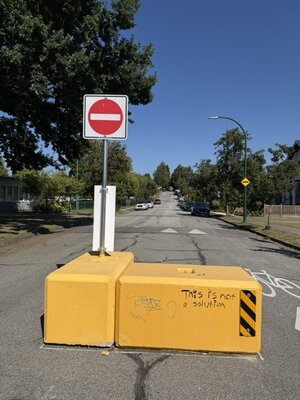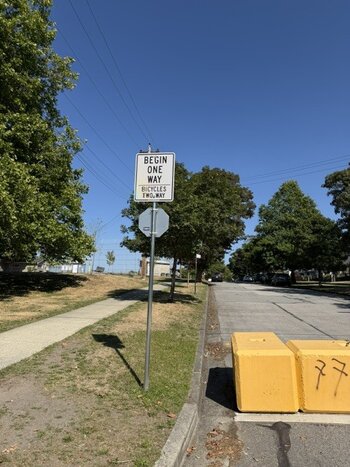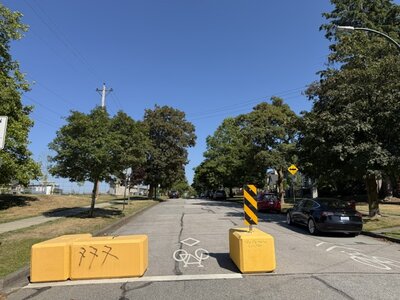
Accessibility demands simplicity. When streets become a long series of twists, turns, and unexpected barriers, those struggling with visual disabilities may find their travels greatly - and dangerously - undermined. According to Statistics Canada, an estimated 2.2 million individuals suffer from issues with their sight; and the introduction of improper traffic calming measures can hinder their ability to navigate the roads.
A survey of 163 legally blind pedestrians found that 85% had difficulty crossing the street when unexpected features (such as medians or islands) were present. In the same survey, 79% of participants struggled to identify the destination corner, 75% veered because parallel traffic did not provide a clear cue, and 70% said that poorly designed streets made it harder to maintain their direction.
The challenges can begin before even attempting a crossing, however. In research involving 557 approaches to unfamiliar streets, 39% of blind pedestrians using long canes failed to detect the street and stop before entering it when using curb ramps. Researchers linked the problem to improper slope, transitions, and placement. Additionally, in experiments at roundabouts, blind participants were approximately 2.5 times less likely than sighted participants to judge traffic gaps correctly.
These findings showcase the concerns traffic calming can bring - with poorly designed measures impacting accessibility. Those living with visual disabilities can find themselves forced to navigate a confusing series of obstacles... rather than experiencing the safety promised by policymakers.
We must ask: where, precisely, is the advantage?
Sources
1. American Council of the Blind — Survey of Signalized Intersection Accessibility. Survey findings on islands, crossing alignment, traffic cues and unfamiliar intersections.
2. Bentzen & Barlow (1995) — Impact of Curb Ramps on the Safety of Persons Who Are Blind. Research covering 557 approaches to unfamiliar streets.
3. Guth et al. (2005) — Blind and Sighted Pedestrians’ Judgments of Gaps in Traffic at Roundabouts. Experiments comparing traffic-gap judgments by blind and sighted participants.
4. Statistics Canada — Report on visual impairment.
Traffic Calming Effects In East Vancouver
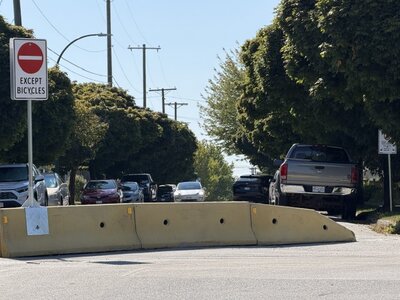
Traffic Calming Undermines Accessibility In East Vancouver